Currently Viewing Posts in currency

The Norwegian Krone

Norwegian Krone information

A few weeks ago we recomended a very attractive destination for your holidays: Norway. Now we want to talk a little more about its currency, its history, the exchange and the legal banknotes that are in circulation and you will use if you visit this beautiful country.

Introduction of the Krone

The Norwegian krone (in the plural, kroner, whose ISO 4217 code is NOK) was introduced in the nineteenth century specifically in 1875, replacing the Norwegian speciedaler at a rate of 4 kroner = 1 speciedaler. In doing so, Norway joined the Scandinavian Monetary Union, which had been established in 1873. The Union persisted until 1914 but, after its dissolution, Denmark, Norway and Sweden all decided to keep the names of their respective and now separate currencies.

The Norwegian Krone

Norwegian banknotes and coins

In Norway you can find banknotes of 50, 100, 200, 500 and 1000 Kroner and coins of 20, 10, 5 and 1 Krone. What we recommend is that you look at the page of the National Bank of Norway where you can see the colors and images that they use in each banknotes and coins. Here we leave the link to that you make yourself familiar with them: Norges bank

The rate of Norwegian Krone

In our web page Eurochange  you can see the daily exchange rates for euro and Norwegian Krone. You will see that in our website there are both prices, the purchase price and sale price, the first you will have to apply it in case you have NOK and you want to get EUROS and the second in the event that you have EUROS to exchange to NOK.

For example, today September 02 2014, if you have 100 euros and you want to buy Norwegian kroner, you would get 833 NOK. If you had 300 euros we would give you 2500 NOK. You can use our converter to confirm what you would get with any amount.

We recommend you book your Krone a few days before your trip, via our web site, at the following link: Eurochange

And now only to wish you a happy trip!

The pound sterling passing to plastic

England has chosen to withdraw paper money by polymer

Libras esterlinas de plastico

There are already several countries that have chosen to withdraw the paper note to manufacture polymer banknotes: New Zealand, Mexico, Singapore and Canada. The last to join in this trend has been England. The reasons being that in these countries they are able to save in the long term as there is no need to keep renewing notes, as they are more durable. They are resistant to dirt and moisture and it lasts up to 2.5 more times than the paper banknotes confirmed the vice president of the Bank of England, Charlie Bean.

However, although a change in the material, the design and the size of the notes will remain the same: "it will remain the same size scale, by which the higher denominations are larger, and will continue to show the effigy of the Queen of England and universally recognized personalities" stated C. Bean.

It is anticipated that the first note to be issued will be the 5 pounds note in the year 2016, which will be represented by the well-known face of Winston Churchill, the second polymer note will be the 10 pounds with the image of Jane Austen in the year 2017. Although to accomplish the change the citizens must be in favor (the Bank of England has organized several presentations during the next few months to collect views and opinions and run only in the event that the citizens agree).

Source of the news : graffica

Pound Sterling

Information Pound Sterling

Pound Sterling

The pound sterling (symbol: £; ISO code: GBP), commonly known simply as the pound, is the official currency of the United Kingdom (England, Scotland, Wales and Northern Ireland), Jersey, Guernsey, the Isle of Man, South Georgia and the South Sandwich Islands, the British Antarctic Territory and Tristan da Cunha. It is subdivided into 100 pence (singular: penny). A number of nations that do not use sterling also have currencies called the pound.

Sterling is the fourth most traded currency in the foreign exchange market, after the United States dollar, the euro, and the Japanese yen. Together with those three currencies it forms the basket of currencies which calculate the value of IMF special drawing rights, with an 11.3% weighting as of 2011 (USD 41.9%, Euro 37.4%, Yen 9.4%). Sterling is also the third most held reserve currency in global reserves (about 4%).

Source: Pound sterling

Do you need to exchange your euros into sterlings? Check our daily exchange rates in Eurochange

About 50-krona and 1,000-krona banknotes (SEK)

Information Swedish Krona

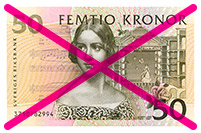
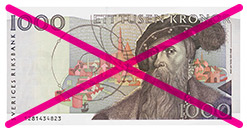
50-krona and 1,000-krona banknotes without a foil strip became invalid after 31 December 2013

After 31 December 2013, you are no longer able to pay with the older versions of the 50-krona and 1,000-krona banknotes that do not have foil strips. The reason these notes are no longer legal tender is that the Riksbank wishes to reduce the number of banknotes and different versions of banknotes prior to the introduction of the new series of banknotes and coins, which will start in 2015.

28 February is the last day that the banks can redeem the notes

Until 28 February 2014 you will still be able to deposit the invalid banknotes in a bank account. After 28 February 2014 the Riksbank can redeem the invalid banknotes, for an administration fee of SEK 100.

Banknotes invalid after 31 December 2013

Picture of 50-krona note without foil strip

Picture of 1000-krona note without foil strip


Banknotes valid after 31 December 2013

Picture of 50-krona note with foil strip


United States Dollar

Information United States Dollar

US Dollar

The United States dollar (sign: $; code: USD; also abbreviated US$), is referred to as the U.S. dollar, or Federal Reserve Note. It is the official currency of the United States and its overseas territories. It is divided into 100 smaller units called cents.

The U.S. dollar is the fiat currency most used in international transactions and is one of the world's most dominant reserve currencies. Several countries use it as their official currency, and in many others it is the de facto currency. It is also used as the sole currency in two British Overseas Territories: the British Virgin Islands and the Turks and Caicos islands.

Today, USD notes are made from cotton fiber paper, unlike most common paper, which is made of wood fiber. U.S. coins are produced by the United States Mint. U.S. dollar banknotes are printed by the Bureau of Engraving and Printing and, since 1914, have been issued by the Federal Reserve.

Dollar sign $

The symbol $, usually written before the numerical amount, is used for the U.S. dollar (as well as for many other currencies). The sign was the result of a late 18th-century evolution of the scribal abbreviation "ps" for the peso. The p and the s eventually came to be written over each other giving rise to $.

Another popular explanation is that it comes from the Pillars of Hercules on the Spanish Coat of arms on the Spanish dollars that were minted in the New World mints in Mexico City, Potosí, Bolivia, and in Lima, Peru. These Pillars of Hercules on the silver Spanish dollar coins take the form of two vertical bars (||) and a swinging cloth band in the shape of an "S"

Source: Wikipedia.

Check the current banknotes and coins: Greenwich mean time

Check our USD exchange rate (as selling as buying) in Eurochange

Houblon £50 pound note to be withdrawn

Information Houblon £50 pound note

Bank of England advises people to spend bank notes bearing portrait of first governor of Bank of England by 30 April (click here to see the information Bank of England

Houblon  50 note to be withdrawn

Around 63m £50 banknotes bearing the portrait of the first governor of the Bank of England, Sir John Houblon are to be withdrawn from circulation in 15 weeks' time.

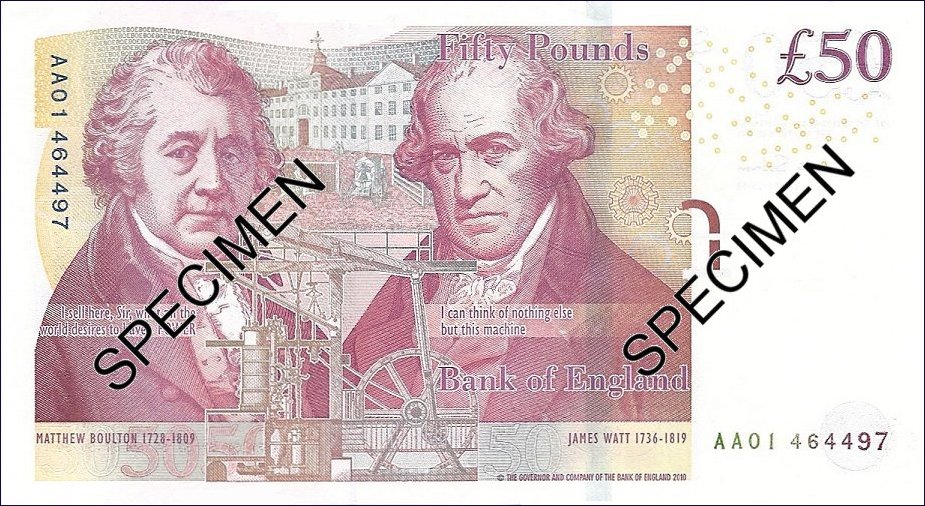
£50 banknote featuring Matthew Boulton and James Watt

From April 30, only the £50 note which celebrates the 18th century business partnership of entrepreneur Matthew Boulton and engineer James Watt, who helped forge the Industrial Revolution, will hold legal tender status, the Bank of England said.

Around 224m £50 notes worth £11.2bn are in circulation, of which the Bank estimates 63m with a total value of £3.2bn are Houblon notes.

From May onwards retailers are unlikely to accept the Houblon notes as payment, but most banks and building societies will still allow customers to deposit them into their accounts. However, agreeing to exchange the notes after 30 April will be at the discretion of individual institutions.

Barclays, NatWest, Royal Bank of Scotland (RBS), Ulster Bank and the Post Office have agreed to exchange the older-style £50 notes for both customers and non-customers up to the value of £200 until 30 October.

In a video placed on YouTube, Victoria Cleland, head of notes division at the Bank, advises people: "If you have any Houblon £50 notes, it's best to spend, deposit or exchange them before 30 April": What to do with old 'Houblon' £50 notes

*Source: The guardian

American Express Travelers Cheques

In the Eurochange exchange offices you will be able to exchange your cheque

Did you know that in our Exchange offices you can exchange your American Express Traveller's cheques?

In the Eurochange exchange offices you will be able to exchange your American Express traveller's cheques into Euros. You just have to bring us an ID (such as passport or driver`s licence) to do the exchange.

American Express locator eurochange

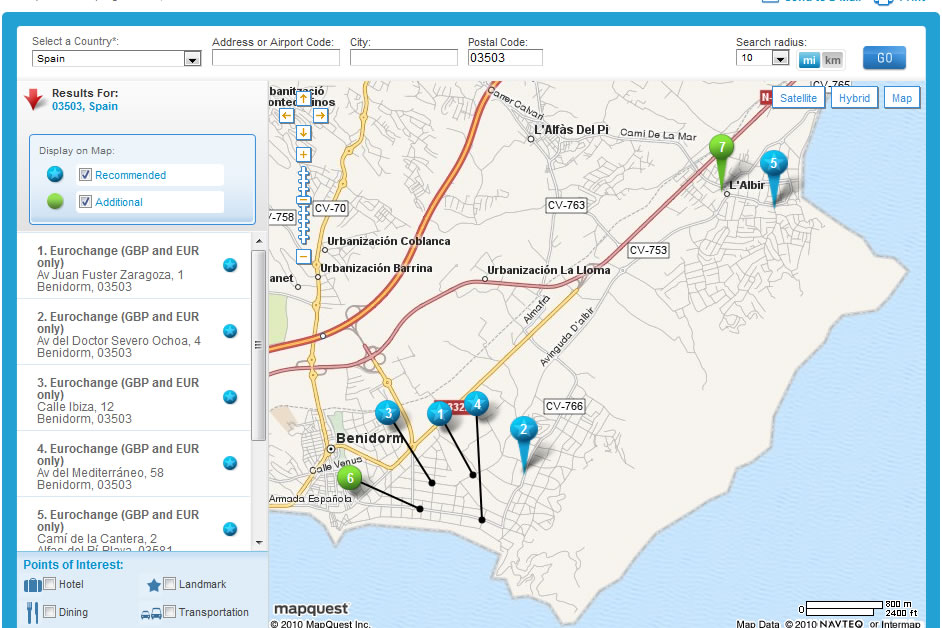
In any traveller's cheques internet browser, you will see the exchange offices from the Eurochange network: Jávea, El Albir, Benidorm, El Campello, Torrevieja, La Zenia, Los Alcázares, Mazarrón or Mojácar.

For example: American Express Travelers Cheque

If you have any question, you can get in touch with us by calling 615.403.877

New 10 euro banknote

This is how the new 10 euro banknote will look like

A few months ago, we shared a news about the introduction of the new five euro banknote of the Europa series.

New ten euro banknote

Now, we advertise the introduction of the second new banknote from the Europa series: the ten euro note. This new introduction was announced by the European Central Bank (ECB) which notified that the new 10€ note will enter in circulation progressively form the 23rd of September 2014. The design of the new note, following the style of the first series in 2002, will add technological improvements to protect them against counterfeiting. The new banknote, as the 5€ one issued last year, will incorporate the hologram and in the watermark a portrait of Europe, a figure of the old Greek mythology which gives the name to our continent, only to make easier its verification by using the simple: FEEL, LOOK and TILT method.

Besides, it will include an emerald number which displays an effect of the light that moves up and down. The varnish layer will make the note to be stronger and it will reduce the costs and the environmental impact.

If you have any doubts about any notes, do not hesitate to ask our employees.

Moreover, if you want to know more about the euro notes, visit the official website of Bank of Spain.

Subscribe to our Blog

Enter the captcha
I agree to the Privacy Policy and Terms of Service.
texto_cookies_html

Guardar configuración actual

This site is registered on wpml.org as a development site.