Currently Viewing Posts in currency

The Danish Krone

Danish Krone information

The Danish Krone is the official currency of Denmark, Greenland and the Faroe Islands, the ISO 4217 code is "DKK" and the symbol they use for currency is "kr". Each Krone is divided into 100 Øre.

History

The first Danish Krones were minted in the XVII Century. In 1873 Denmark, Sweden and Norway formed a monetary union to use a common currency, the krone. With the arrival of World War II, the union was dissolved. But the three countries continued calling their currencies Krones.

Coins and Banknotes

There are 6 Danish Krone bank notes: 50, 100, 200, 500 and 1000 krones. On one side of the note shows images of existing bridges in Denmark representing different architectural styles. On the other side you can see antique objects found near the bridges represented. In addition, a map is displayed with the location of the findings.

Danish Coins are 50 Øre, 1, 2, 5, 10 and 20 krones. The image that appears on the coins is of Queen Margrethe II, the coat of arms and the crown.

If you want to familiarize yourself with the krones before your trip, you can see how they are on the website of the National Bank of Denmark.

The Faroe Islands krone

There is a specific issue of Krone for the Faroe Islands as the Bank of Denmark is obliged to issue notes with texts in Faroese. However, this issue has no legal validity in Denmark, just as the Danish Krones are not valid in the Faroe Islands. The exchange rate is 1: 1, so its value is the same and can be exchanged free of charge at the National Bank of Denmark and Danish crowns can also be exchanged in the Faroe Islands.

Danish Krone Rate

The rate of the Danish Krone changes daily. In our table of rates you can see the daily rate and whether it goes up or down. If you want to reserve DKK, go to our “RESERVE” section and fill in the form. You can pick them up in any of the collection exchange offices on the date you specify. Please note that the final price will be on the day of collection.

If, however, you want to keep the rate of the day you reserve because you will get more krone for your euros, you can go to the “BUY” section and you can purchase your krone at that very moment. This way you can keep the rate of the day and have your krones sent to your home in 24-72 hours (depending on the stock of currency).

Remember on your return trip, you can exchange your spare krones to Euros at our exchange offices. But only notes, don’t forget to spend them left over coins or exchange while you’re over there.

Have a nice trip!

Russian Ruble

Russian Ruble information

Russian Ruble notes

The ruble is the currency used in Russia, Abkhazia, South Ossetia, Belarus and Transnistria. In this post we will focus on the Russian Ruble, the official currency of the Russian Federation, Abkhazia and South Ossetia.

Its ISO 4217 code is RUB. And although its symbol was for many years a "y" with a "p" crossed, since 2013 it was decided that the ruble would have a symbol "P" with a horizontal line: ₽.

History

The first dating from the word "ruble" use comes from the Thirteenth Century and consisted of parts of the hryvnia. In 1704, the ruble became the first decimal currency because 1 ruble equaled 100 copper kopecks. After the Russian Revolution, the Soviet ruble was introduced as the official currency and it was until 1991. From this date the former Soviet republics were acquiring their own currencies and the Russian Federation began broadcasting Russian rubles.

Notes and coins

Both banknotes and coins are issued by the Bank of Russia. Rubles banknotes are divided into: 5, 10, 50, 100, 500, 1000 and 5000 rubles. There are several editions (1997, 2001, 2004, 2010) and to date all have legal validity. At the bottom of each ticket you can see the year of issue.

As for coins, there are 1, 5, 10 and 50 kopecks and 1, 2, 5 and 10 rubles. The coins of 1 and 5 kopecks were stopped in 2012 due to little use made of them, however, they remain in circulation. If you want to familiarize yourself with the notes and coins that you can use on your trip to Russia, visit the website of the Bank of Russia: Central Bank of the Russian Federation.

Rate of the Russian Ruble

In our table of rates you can check the daily rate of the Russian ruble. And you can make a reservation and have them prepared and ready for your trip.

A very important thing to note is that, exchange offices and Russian banks do not accept any folded, wrinkled or any slight imperfection bank notes. For this reason we recommend that you avoid any problems that may occur during your holiday and exchange your Euros for Rubles before the trip.

Also, you do not want to waste your holiday time in queues to buy rubles right?

Have a nice trip!

New currency available: Hong Kong Dollar

Information Hong Kong Dollar

We continue to increase our offer of currencies and from today onwards we have a new currency available: Hong Kong Dollar (according to ISO 4217 its abbreviation is HKD).

Hong Kong and China

Hong Kong belongs to China, however it's considered a Special Administrative Region. This region was colonized by the United Kingdom until 1997 and after decolonization, it was very difficult to adhere to the Communist system of the rest of China.  Therefore Hong Kong enjoys a certain autonomy and a system closer to the Western one. For this reason also has its own currency.

History

Until 1863 Hong Kond didn't have its own currency and they used to trade with the currency from China or from many foreign countries. From this year first Hong Kong Dollars were minted. However it wasn't until 1935 when it was definetly established as the official currency of the Hong Kong territory. Nowadays the coins are minted by the Government and the notes are issued by three licensed banks:  Standard Chartered Bank,  HSBC and the Bank of China.

Notes and Coins

The current Hong Kong Dollar banknotes are divided into 20, 50, 100, 500 and 1000 dollars. On them you can see different traditional celebrations of the region, landscapes and inventions from China.

If you want to see the notes and familiarize yourself with them before your travel, visit the site from the Hong Kong Monetary Authority.

The Hong Kong Dollar coins are divided into 10, 20 and 50 cents and 1, 2, 5 and 10 dollars. On one side all the coins have an imagen of bauhinia blakeana, also known “Hong Kong orchid tree” and, in the other side, you'll see the value and the year of mint. If you want to see how are the coins that you will receive there, you can download this pdf file: Leaflet_e.pdf

Hong Kong Dollar Rate (HKD)

You can check the Hong Kong Dollar daily rate in our website.

Moreover you can make a reserve to have you Dollars available for your trip.

And don't be worried about your leftover Dollars. Back from your trip, you can go to your nearest branch to exchange the Hong Kong Dollars back into Euros. Remember, just notes, not coins.

Have a nice trip!

New currency available: Polish Zloty

Information about the Polish Zloty, official currency of Poland

Notes of Polish Zloty PLN

In Eurochange we continue to increase currencies so you can use our service whatever your destination. On this occasion, we have incorporated the Polish Zloty. Let us tell you a little more about this new currency.

The Polish Zloty

The Zloty is the legal currency in Poland, the abbreviation ISO 4217 is PLN, but the abbreviation used to mark prices is “”. Each Zloty is divided into 100 groszi.

History of Zloty

The Zloty, Zloty literally means "golden", has been the currency of Poland since the fifteenth century, occasionally replaced by other currencies (such as rubles or marks) according to the government of the day. However it was not until 1995 when the Zloty we know as today was established. The Polish National Bank is responsible for issuing the coins as notes.

Banknotes and coins

Zloty banknotes are divided into 10, 20, 50, 100 and 200 zlotys. In 2014 the Polish National Bank renewed the design of banknotes of 10, 20, 50 and 100 zlotys and, for the moment, both editions are legal tender.

Zloty coins are 1, 2, 5, 10, 20 and 50 grosz and 1, 2 and 5 zlotys.

On the website of the National Bank of Poland you can see how are these notes and coins are to familiarize yourself with them before your trip: Narodowy Bank Polski

The Future of the Zloty

It is expected that from 2020 to begin the process to acquire a single currency in Poland. But for now, you have to exchange your currency before you travel.

Zloty rate

The Polish Zloty rate varies daily as other currencies we have available in Eurochange. You can use the currency converter on our website to see how many zlotys we would give you for your Euros. To ease the task of getting zlotys in Eurochange you can make a reservation and have your zlotys available for the dates you want. In addition, when you get  back from your trip you can exchange your leftover zlotys into Euros again. But remember that we only accept notes, so you´ll have to spend the coins before your return or keep as a memento of your adventure in Poland.

Have a nice trip!

Detect fake pound notes

Being alert that you don’t get “sliped” a fake note.

Sterling Pound banknotes

Traveling to countries that use a different currency of your own is complicated. Not only must you be attentive to exchange rate and calculate what you are really spending, but also being alert that you don’t get "sliped" a fake note.

In Eurochange we want to prevent you from having these kind of problems because of not knowing the currencies of the countries you visit. Therefore we regularly publish posts in which we explain the notes of each currency or notes that have been taken out of circulation.

In our post today we give you some tips to discover if your Sterling Pounds are fine or fake.

Previous warnings

You should pay special attention when you get change in low visibility places: a pub, a nightclub,… Check the notes in front of the person who gave them to you, so you can claim at the time.

What should I check for?

Detecting fake pounds

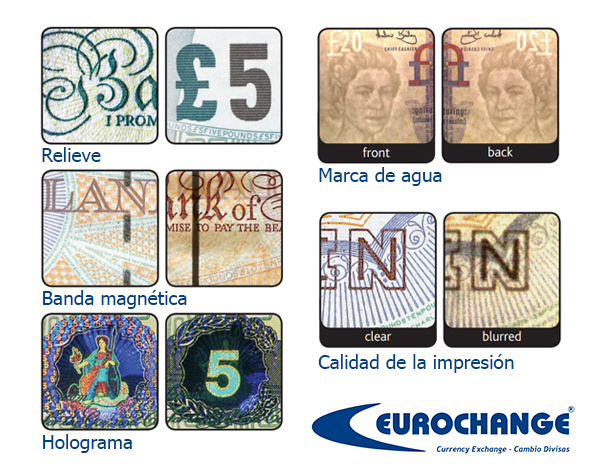
Some security measures are more difficult to see like the marks underneath ultraviolet light, but here are some quick and easy tips:

  • Paper and relief: At the moment Sterling Pounds notes are printed on cotton paper, so we are familiar with the distinctive feel of paper. Furthermore,the amount and the inscription "Bank of England"are embossed.
  • Magnetic stripe: all notes have within a magnetic stripe, putting them up to the light you can see a dark line that passes through them.
  • Hologram: 5, 10 and 20 pounds notes have holograms. By turning you will see two images in different bright colors.
  • Watermark: Putting them up to the light you will see a water mark with the image of the Queen of England.
  • Print quality: most counterfeits fail to have the same print quality than real notes, check that the print is clear and not blurred.

With these tips you should be safe from receiving a fake note. If you want further information you can download this brochure you will find all the information on security measures Bank of England

In Eurochange we are aware of the importance of fighting counterfeiting. For this reason we have several systems to detect counterfeits such as ultraviolet light or detector pens.

Remember you can book your sterling pounds in advance or bring your left over pounds from your trip.

Want to see more information about the pound? Read Sterling Pound or New £5 note.

The Australian Dollar

Australian Dollar information

Australian Dollar

The Australian Dollar is the official currency of Australia, the Christmas Islands, Coco Islands, Norfolk Island and the independent Pacific Island states: Nauru, Tuvalu and Kiribati Islands. Its ISO 4217 code is AUD and although its symbol is the dollar sign "$" is often represented preceded by an A "A$" (Australian Dollar) to differentiate it from other types dollars.

History

The Australian Dollar was introduced in 1966. Until then the legal currency was the Australian Pound. The first Dollar banknotes were 1, 2, 5, 10 and 20 dollars. Years later 50 and 100 notes were included and the 1 and 2 notes were replaced for coins. The issue of the Australian Dollar is regulated by the Reserve Bank of Australia and coins by the Royal Australian Mint.

Banknotes and coins

Australian Dollar banknotes legal tender are of 5, 10, 20, 50 and 100 dollars. Between 1992 and 1996 the printed cotton paper banknotes were replaced by polymer, so the dollars in circulation today are made of the more durable and harder to fake material.

The Australian Dollar has 8 coins: 1, 2, 5, 10, 20 and 50 cents and 1 and $ 2. They are represented elements of nature and tradition and Australian culture.

Visit the pages of the Reserve Bank of Australia and the Royal Australian Mint to familiarize yourself with the notes and coins before the trip.

Rate

The rate of the Australian Dollar changes daily. With our currency converter you can check the daily rate and how many dollars you would get for your euros and also know how many euros we would give you for your Australian Dollars if you have any leftover after your trip. Remember you can reserve online Australian Dollars in advance to have them available for the dates you choose.

Have a nice trip!

The Swiss Franc

Information about the Swiss Franc, official currency of Swizterland

Swiss Franc

The Swiss Franc is the official currency of Switzerland and Liechtenstein. Its ISO 4217 code is CHF although it is common to see the abbreviation Fr unofficial areas. In German it is called Franken, in Italian franco and in French and Romansh franc. As in Switzerland they have these 4 official languages, you are likely to hear any of the three ways.

History Swiss Franc Until 1850 the Swiss monetary system was very complex, since the coin was made almost locally and in the country there were about 8000 different notes and coins at a time. In 1850 the Swiss Franc was  adopted as the only single currency and its manufacture was regulated. Today the notes are issued at the Swiss National Bank and the coins at the Swiss Mint.

Banknotes and coins The Swiss Franc is divided into 100 cents (Rappen in German, centime in French, centesimo in Italian, and rap in Romansh). There are 6 Bank notes: 10, 20, 50, 100, 200 and 1000 francs; and 7 coins: 2, 10 and 20 cents, ½, 1, 2 and 5 francs. On the Swiss National Bank website you can check the design of the banknotes and coins to familiarize yourself with them prior to travel.

Swiss Franc quote With our currency calculator you'll know how many Francs we would give you for your Euros and you can place a reservation to ensure that they are available for your trip. Furthermore, if the return journey you have leftover Francs, you can also exchange them for Euros at our exchange offices. But remember that we only we can exchange notes. Keep this in mind and spend your left over coins on last minute souvenirs or a quick coffee before catching the flight back.

Have a nice trip!


Goodbye Litas

Lithuania will become the nineteenth member country of the Eurozone.

On 23 July 2014 the European Parliament approved the entry of Lithuania in the Euro Zone.

Litas - Official Lithuanian Currency

Member of the European Union since 2004, requested to join the Euro in 2007-2008. However, this request was rejected for having inflation slightly above the allowed limit and it was not until this year when the country has finally reached all the requirements to enter the single currency framework.

On January 1, 2015, Lithuania will become the nineteenth member country of the Eurozone. The change will be 3.45280 LTL per euro. The Lithuanians have a period of two weeks to get used to the new currency as from January 16, 2015, the litas will cease to be legal tender.

The design of the national side of euro coins Lithuanian was introduced in November 2004 and is composed by the 12 stars of the European Union, the word LIETUVA and the coat of arms of Lithuania known as Vytis.

In the case of banknotes, as since its introduction in 2002, will be identical to those in legal tender today.

We now have one more!

The Canadian Dollar

Canadian Dollar information

The Canadian dollar (ISO code 4217: CAD) is the currency of legal tender in Canada.

It is the official currency since January 1st 1858, the year in which it was ordered that all accounts were to be made in dollars and the emission of the first banknotes and coins. This was when British pound and the Spanish dollar were abandoned, which was in circulation among the Canadian territories at the time.

Polymer Notes

In 2006 the Bank of Canada decided that in the year 2011 the Canadian dollar would be made from polymer. This material makes the notes more durable and more difficult to counterfit, in addition its way of manufacturing is more eco-friendly. In Europe, the United Kingdom announced a few months ago that they also will pass to this material beginning with the manufacturing of the 5 pound note in polymer.

Banknotes

The banknotes of Canadian dollar are 5, 10, 20, 50, and 100 dollars and its new design evokes the spirit of innovation in the country. On one side there are images of notable Prime Ministers in its history, as well as the image of the Queen of England on the note of $20. On the other side they commemorate their innovations in the fields of medicine and technology. Do you want to see them? Here are the designs of the Canadian dollars.

Coins

A curiosity about the Canadian coins is that they are not made by the Bank of Canada, they are manufactured in the Royal House of Mint. The amounts are 1, 5, 10, 25 and 50 cents, $1 and $2. On one side, the coin displays the image of the Queen of England and on the other side we appreciate different designs relating to the Canadian life and history. It is very common to see designs of nature with native animals.

Canadian dollar

Just like the rest of foreign exchange, the rate of the Canadian dollar changes daily. In our web page you can see the daily rate and use our currency converter to make the calculation of the amount that you would recieve if you wanted to exchange from Euro to Canadian Dollar also from Canadian dollar to Euro.

You can also book the amount you need through our web page on exchange reserves.


The Swedish Kroner

Swedish Kroner information

The Krone is the official currency of Sweden since 1873 as a result of a monetary union between Sweden, Norway and Denmark. When this union was dissolved with the start of the World War I, the three countries decided to keep calling their currencies with the same name. For this reason we have the Swedish krone, the Norwegian krone and the Danish krone. The ISO 4217 code  is SEK.

In 2011, the Riksbank (Central Bank of Sweden) prepared a contest that was held in 2012 to design the new banknotes. The winning piece was "Kulturresan" (Cultural trip) Göran Osterlund. In this cultural series of banknotes, appears different relevant characters of the Swedish culture. For example, in the note of 100 krone we will see the image of Greta Garbo, an actress that was born in Stockholm. Another novelty is that they will introduce a new note of 200 krone to facilitate payments and change in amounts of between 100 and 500 krone.

These new notes will come to light in 2015 and the old notes will no longer be in circulation progressively from that time.

The coins also are going to go through a modernization. The new krone coins will be smaller and lighter than the current ones while keeping the same layout. In addition they are also bringing back the coin of 2 krone that not been minted since 1971.

In the case of the coins, we will have to wait until 2016 to see them in circulation.

More information about swedish bankontes and coins. Remember, if you are going to visit Sweden, you can reserve your swedish krones in advance in our web and you can check the daily rate.

We have a new 10 euro note

The new 10 euro note has been introduced into circulation.

Today, September 23 2014, the new 10 euro note has been introduced into circulation.

The note follows the line that came out a few months ago with the new 5 euro note (it’s called the Europe Series) and it is expected that little by little the banknotes that already exist in circulation will be updated.

This new series makes the note more difficult to counterfeit and in addition the material in which they are manufactured is more durable than the previous one. This is especially important for the smaller notes that are the fastest to wear.

In the official website of the euro banknotes have images to see the differences between the two notes.

5 pound note

Polymer 5 pound note information

A few weeks ago we mentionned that the UK will be the next country to leave the old paper notes and start to manufacture the new polymer notes (a thin plastic sheet) (see pound sterling passing plastic)

Polymer 5 pound note

Well, the first note to be manufactured in polymer will be £5 and it will see the light in 2016. The final aspect will be very similar to the present note: the image of the Queen of England on one side and the Winston Churchill on the other.

The Bank of England conducted a campaign of public consultation to decide if they should implement this change. Around 13,000 people participated in the campaign. A 87% were in favor of the change, a 6% against and a 7% neutral.

The polymer banknotes were used for the first time in Australia in 1998. This material allows the note to incorporate security measures that cannot be given in the paper cotton note and in addition its more durable and resistant. The unique feature of the polymer banknotes is the possibility to include a transparent window and more security measures that can not be applied to the traditional notes. More information about security: Bank of England

Also it is a sustainable option since they are more durable (approximately 2.5 times more durable than paper) and they do not need to be revamped so often.

Do you want to reserve your pounds with us? Visit our web page Eurochange

Subscribe to our Blog

Enter the captcha
I agree to the Privacy Policy and Terms of Service.
texto_cookies_html

Guardar configuración actual

This site is registered on wpml.org as a development site.